
Insect Biomechanics Workgroup
How do animals and plants function mechanically?
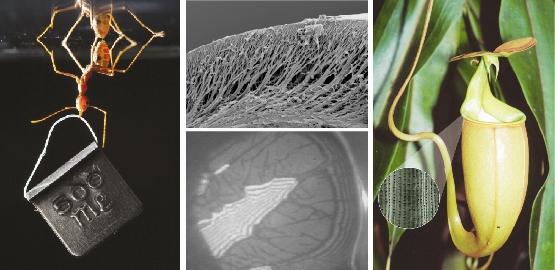
Our research aims to clarify how animals work and how they are adapted to survive in their environment. We study insect locomotion with a focus on the biomechanics of surface adhesion and its ecological context in interactions with plants. One of the questions we have been investigating is how insects are able to run with sticky feet and what adaptations they have evolved to solve the conflict between adhesion and locomotion.
We study insect-plant interactions where mechanical factors play a dominant role (leafcutting ants, Macaranga ant-plants and Nepenthes pitcher plants). Apart from field work (mainly in tropical Southeast Asia), the methods used in our laboratory range from force measurement at different size scales to morphometry, interference/fluorescence and electron microscopy, atomic force microscopy and 3D high speed motion analysis.

Projects
- Design and function of adhesive systems
- Locomotion and adhesion
Biomechanics and ecology of insect-plant interactions
Key Publications
Clemente CJ, Goetzke H, Bullock JMR, Sutton GP, Burrows M & Federle W (2017) Jumping without slipping: leafhoppers (Hemiptera: Cicadellidae) possess special tarsal structures for jumping from smooth surfaces. J. R. Soc. Interface. 14. 20170022.
Labonte D, Clemente CJ, Dittrich A, Kuo C-Y, Crosby AJ, Irschick DJ & Federle W (2016) Extreme positive allometry of animal adhesive pads and the size limits of adhesion-based climbing. Proceedings of the National Academy of Sciences, USA 113, 1297-1302
Zhou, Y., Robinson, A., Steiner, U., Federle, W. (2014): Insect adhesion on rough surfaces: analysis of adhesive contact of smooth and hairy pads on transparent microstructured substrates. J R Soc Interface, 11(98): 20140499
Endlein, T. & Federle, W. (2013): Rapid preflexes in smooth adhesive pads of insects prevent sudden detachment. Proc. R. Soc. B 280(1757): 20122868
Scharmann, M., Thornham, DG., Grafe, TU. & Federle, W. (2012): A novel type of nutritional ant-plant interaction: ant partners of carnivorous pitcher plants prevent nutrient export by dipteran pitcher infauna. PLoS ONE 8(1): e63556